Showing posts with label National Parks. Show all posts

Saturday, July 21, 2012

Medora Redux


I was all set to write a blog post about our return visit to Medora, North Dakota and its Pitchfork Fondue and Musical when I decided to check my journal from the year 2001.  Sure enough, I found our previous visit logged there on August 30, 2001.  So what follows is the narrative from 2001, but the photographs are from this year's visit since I didn't get a photograph of the steaks from the Pitchfork Fondue the last time around.  I've already blogged and posted photographs of our visit to the south unit of the Theodore Roosevelt National Park but this post has a little bit of additional information.
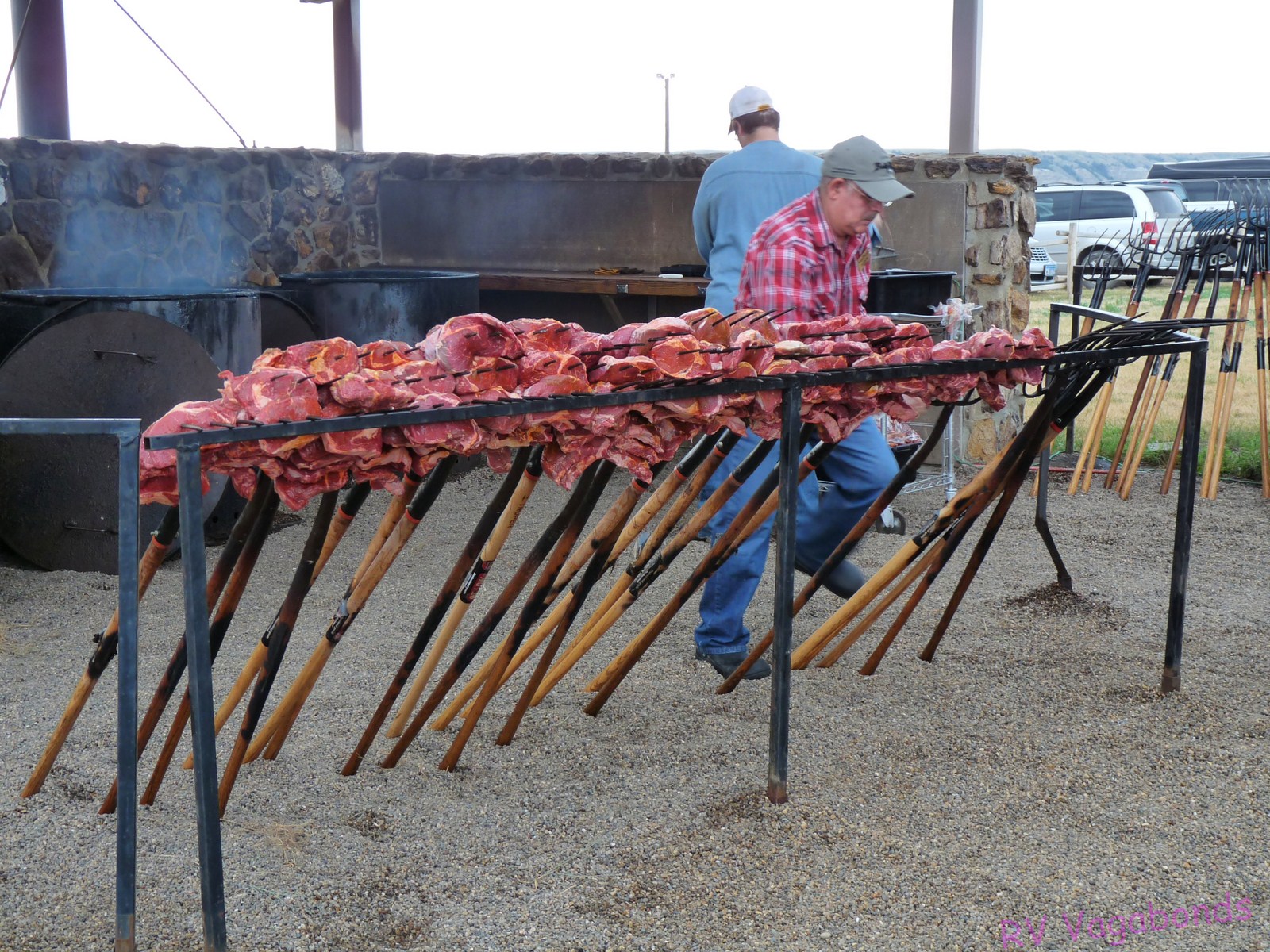
 Thursday. August 30- Denny started the morning off by changing the oil in the truck, then we dropped off the old oil. I had packed a picnic lunch and grabbed the cameras, so after that we headed for Medora and the south unit of Theodore Roosevelt National Park. It was about 33 miles away, and we stopped first at the Painted Canyon visitors’ center where we purchased a great bird book, then lunched while overlooking the Badlands. We then pushed on to Medora, the town on the edge of the park and decided we’d have to check out the town after doing the park, as it was all rustic buildings. We stopped at the Harold Schaefer center for our tickets to the Medora Musical that I had ordered, and Denny got to talking with an elderly volunteer who explained who Harold Schaefer was; he grew up in Bismarck, and was enamored of Teddy Roosevelt, and started marketing a product called Glass Wax, which became a huge hit, and then later he marketed Mr. Bubble, which was an even bigger hit. He wasn’t into the manufacturing end of the business, he’d just find a good product he believed in and then marketed the hell out of it, making the product successful. It worked, and he began pouring money into Medora to rebuild it. They have a nice little museum about his life and his company and it was really interesting. Anyway the old guy talked us into trying the “pitchfork fondue” dinner before the show, so we bought tickets to that also.
We headed into the park, and right away found the prairie dog cities. These were right next to the road, so the little guys just ignored the cars since they were so used to their presence, unlike the ones at the north unit where you had to hike back a mile to see them, so they were unused to people and no cars were around. We saw several elderly male lone bison, which the volunteer had explained were males no longer to fulfill their duties as stud and herd leader, so they were chased out by the herd to live out their remaining days alone. We also saw a herd of wild mustangs in the distance, but were unable to get close enough to take pictures. It is an awesome area and well worth the trip. After exploring the park, we wandered around town a little, then sat on a park bench and read the newspaper until it was time to head up to the dinner and show. The dinner consisted of crudities and dip, coleslaw, cubed melon, baked potatoes with butter and sour cream, rolls, baked beans and brownies and a big rib eye steak which they threaded on a real pitchfork and dropped into huge vats of boiling oil, deep frying them. It seared the outsides and kept the juices inside. Boy were they good, and it was easy to cut them with the plastic utensils we were given. All this while sitting on top of the canyon overlooking the Badlands while the sunset and the almost full moon rose. Not bad. We chatted with one of the ticket takers for a while since we had an hour to kill, then went down to our seats for a really good show. When they introduced the members of the band we were very surprised to hear that the guitar player was from Beavercreek, Ohio!   We certainly didn’t expect that! There was lots of singing and dancing, a stand up comedian, a family of trampoline artists and horses and Teddy Roosevelt and good fiddle playing by a young lady from St. Louis, and fireworks and it was fun! It was a longish ride home on a very dark highway as we were tired, but it was a great day!
2012 version; this year immediately after dinner at the Pitchfork Fondue there was a "trick golfer" who supplied entertainment while we waited to be able to be seated for the Musical.  He did everything from standing on a ball on a table while hitting a golf ball to jumping rope on that same ball to hitting the ball left handed with the right handed driver being held backwards/upside down.  Denny and I spoke with him privately while waiting for our meal and Joey said that he practice 14 hours a day for years to develop his act.
 Before we could be seated for the show, a thunderstorm rolled in and the show was cancelled.  We exchanged our tickets for the next evening.  This is the view of the stage from our seats.
 The show starts off with "The Star Spangled Banner" after the cowboys ride onto the stage.
 It was children's night so there was a "bit" where all kids were invited on stage to receive a gift and be told a brief story.
 
 There are songs and dancing and a live band provides the music.
 Since Teddy Roosevelt built a cattle ranching business and a home here, there's always a section about Teddy.
And some audience participation during a segment involving long distance spitting and a spitoon (all pretend of course.)
It's all good clean fun.  And just to see who is paying attention--because the show was rained out when we exchanged our tickets we were given a second set of tickets to be used any time this year or any time next season until September of 2013.  If someone would like to see the show while traveling in North Dakota this year or next, let me know in the comments.

Tuesday, July 17, 2012

Thanks, Teddy

"I never would have been President if it had not been for my experiences in North Dakota."  That's a quote from Theodore Roosevelt, who came to North Dakota one summer to hunt and who ended up creating the Maltese Cross ranch with a couple of partners and then later building anther residence, Elkhorn Ranch, on his own.  After watching the decline of the bison due to non-stop hunting and disease and seeing the grasslands disappear because of overgrazing by cattle, Teddy Roosevelt became concerned about what was happening in the Dakotas and areas of the west.  Once he was elected president he created several national parks, created the US Forest Service and signed the US Antiquities Act, leading the way in preserving a great part of our heritage; our own beautiful country.


Eleven years ago Denny and I explored some of North Dakota, stopping at both the north and south units of the Theodore Roosevelt National Park.  This time around we stayed in a campground in the town of Medora which is the gateway to the south unit of the park.  Our stay here has seen temperatures reaching 100+ degrees on several days so when the day started out overcast Denny and I jumped in the truck hoping the slightly cooler temperatures would allow the animals of the park to show themselves.  According to the brochures handed out at the ranger station we had the potential to see bison, wild mustangs, deer, elk, prairie dogs, pronghorn antelopes, big horned sheep, badgers and coyotes that live here, but we only managed to see the deer, bison, wild mustangs and prairie dogs. 

The south unit of Theodore Roosevelt National Park has a visitor center near the entrance with a small museum, gift shop and the original Maltese Cross Ranch house which has been moved to its current location.

Once you've checked out the museum, toured the cabin and watched the brief video in the visitor center and checked out the ruins of the meat packing plant on the grounds it's time to jump in your vehicle and start driving the 36 mile loop in the park.  There are a lot of short hiking trails near the overlooks as well as longer hikes throughout the park.  There are also riding trails and a stable that has guided horseback tours available if that's your inclination.  Just bring along a lot of water.  There are also primitive campgrounds available within the park; there are no hook ups there but there are restrooms.

But the main attraction here is miles and miles of scenery and rugged, rocky terrain softened by areas of cottonwoods along the Little Missouri River that winds throughout the park. 


What you won't find here are crowds--this is sort of off the beaten path although its entrance is just a couple of miles from an interstate exit.  So you can wander at your leisure, being enveloped in the scent of sagebrush and immersed in the sounds of silence.  Which we did until the thunderstorms rolled in and we rolled out.
 
Of course, I have to close with an "awwww" moment; this wild mustang foal who was all tuckered out from being so darned cute.

Saturday, September 18, 2010

Our Day in Denali


I'm going to skip a day that includes playing golf near Denali because I don't have access to my scorecard while we're marooned here in the hotel. Instead we'll segue right into our excursion into Denali National Park.

Our bus driver/guide for the day was Joe, a marine biologist by trade. Our trip into Denali was only a drive of 62 miles of its total 92 mile length, but it would take us all day to travel that distance due to the gravel roadway and the many stops for photo opportunities. When I say stops for photo opportunities, this is not getting off the bus and walking around, because when wildlife is near you may not only not get off the bus but you are not supposed to talk because the park staff doesn't want the wildlife becoming acclimated to the sounds of humans. So on a misty and sometimes rainy day our pictures were mostly taken from inside the bus, leaving the quality of the shots somewhat lacking.

Factoids: There are six million acres of land in Denali National Park. The trees are within the boreal forest, the northernmost treeline on the continent, and are comprised of alders, poplar and spruce. There are no pine trees in the boreal forest.

While most of the road within the park is gravel roadway, near the entrance the road is paved and has an underlay of styrofoam as a base to protect the permafrost. Also near the entrance a five mile section of the road is closed to any and all foot traffic during the moose rutting season as a protection both for the moose and humans.

There are 35 species of willow in the park, the dwarf willow being a favorite of caribou. In my pictures you will see a very red plant--that will be dwarf birch although dwarf willow is also red.

In the park there is only a three month period of lush plant and tree growth for the animals to eat before the winter season starts and the plants begin to lose their nutrients. Therefore Denali NP can't support a lot of animals as there is would be too much competition for food for the animals. Nature's way of keeping the animal population under control.

Charles Sheldon watched as Dall Sheep were being hunted to extinction in this area of Alaska and so he lobbied for the area to be made into a national park. He also worked with Theodore Roosevelt and many others to form the Boone-Crockett Club, dedicated to preserving wildlife.

The horns of a Dall Sheep take 7 to 8 years to grow into a full curl and the horns have rings like a tree.

There are currently 2000 caribou in the park.

The only fish in the rivers within the park are the Arctic Grayling, which are the only type of fish that can survive in the glacier silt-filled waters. Therefore there are no bald eagles in the park because they don't eat grayling. There are, however, golden eagles because they eat mammals.

The mineral rhyolite is found in the mountains here. It is also found in Nevada and Arizona.

Scientists come from all over the world to study Alaska and Denali National Park due to its unique climate, animals and topography.If you click on the above picture to enlarge it, you will see the bloody area on the center antler where this male caribou has just finished rubbing the velvet from his antlers.

And now it's time to get out of the room and hit the Shipshewana Flea Market, famous in this area of Indiana. More pictures of Denali to follow. Internet connection willing, that is.

Tuesday, July 27, 2010

Hot Fun in the Summer Sun


Wanting to do something a little different for our anniversary, I planned a morning adventure to the Riverfront Park in Spokane, Washington. Located on the banks of the Spokane River, the one hundred acres of the park is given over to providing fun and entertainment for adults and children alike while also provided a peaceful place to enjoy the falls, the river, the flowers and the trees in the middle of town.

My intent this day had been to start off with a gondola ride over the falls but it seems that the staff closes down the ride when the temperatures get too high. The interior of the glass enclosed gondolas gets a good 15 degrees warmer than the outside temperatures and 100 degree temperatures don't make for a pleasant experience. So we'll have to put the gondola ride on our "we'll do it the next time around" list, which seems to be growing exponentially to our travels.

The Spokane River and Falls are a very obvious highlight of the park. Rushing, tumbling clean green water waters churning over black granite made for great pictures but I'll only include a couple here.

Meandering trails take you back and forth across the river and small tributaries, with totem poles, markers and statuary sprouting up in hidden nooks and quiet corners throughout the park. With the background white noise of the falls, it's a soothing place if you need it to be, or a place of high activity if you're a child as there is a small amusement park with an Imax theatre situated on the grounds. The city has done a great job with this gem of a park.Read about the carousel here.

Although it was uncomfortably hot for our morning jaunt, I'm glad we took the time to visit Riverfront Park--it was well worth it.

Friday, July 09, 2010

Never Listen to a Man on an ATV


I'll get to that.

Upon our arrival at our campground on Monday, the lady at the desk suggested several places to visit in the Glacier area one of which was the Polebridge Merchantile.  Not because of the history, not because of the scenic beauty, but because of their bakery.  Bakery?  'nuff said!  So yesterday's jaunt was to Polebridge to buy some huckleberry beer bread for Patty at the desk and whatever scrumptious goodies we could find for ourselves.  Understand, we were driving 25 miles one way for food; yep, that's the RV Vagabonds for you!
 Imagine our surprise to find the Polebridge Mercantile surrounded by cars and ATVs--apparently the word is out about this place!  Located 25 miles from the west entrance to Glacier National Park, 14 of those miles on dirt road, no electricity, the restrooms are outhouses and the pastries are to die for.  Along with their breads, they apparently bake a sandwich where the meat, cheeses, onions, etc are placed inside the bread and then baked.  Sounds yummy, right? We picked up a bottle of dark cherry cola to wash our huckleberry pear and lemon cheesecake Danishes down and sat on the sawed off logs on the front porch to eat the Danish while it was still warm from the oven.  There were several people wandering around the grounds since they rent cabins (and outhouses) and there's also the Northern Lights saloon/restaurant next door that is on the National Register of Historic Places.  Built by William Adair in 1904 who later built the false fronted Polebridge Merchantile, the log cabin is an attractive place to sit and rest a while, although they don't open until 4 in the afternoon.


After Denny and I finished our Danish, several men pulled up on ATVs.  I asked one of them where the road led that they had come down and he told me they led to Bowman and Kintla Lakes.  He said Bowman was nice, but Kintla was a must-see lake.  I asked if we could take the truck there without a problem and he said sure--the road got narrow in places but we'd be fine.  As the title says, never listen to a man on an ATV.  It took us two hours to drive the 16 pot-hole rutted, one lane scary, scratchy bush line roadway.  Black Beauty now has Montana pin-striping all down her passenger side which I'm hoping I can buff out eventually and Denny's blood pressure went through the roof each time we couldn't avoid a bone-jarring teeth-clattering front end alignment requiring pot hole.  The already blue skies were made bluer by his language, believe me.

After driving for what seemed to be 30 miles, we saw a park ranger by the roadside cutting up a large tree into sections.  Denny asked him how far it was to Kintla Lake and he told us another five miles.  When Denny said how he was tempted to turn around because the road was so terrible and hard on our truck, the ranger told us that the drive was well worth it (now he was the third person to tell us that because we earlier we had stopped by a road crew and asked how far to the lake and were told at that time it was still 14 miles away, but the drive was worth it) and went on to tell us he had been working there 26 years.  His name is Lyle (and I didn't get a picture, darn it!) and at 90 years old, he is the oldest park ranger in Montana.  Heck, at 90 years old, I imagine he's the oldest park ranger in the country!  Denny volunteered to help him cut the remainder of the tree, but he waved us on telling us he'd be following soon.  So we ended up driving the rest of the way--more pot holes, more cussing, more coming off the seat jarring roadway, but we made it.  Was it worth it?  Yes.  I wish we had brought water with us so that we could have taken one of the trails, but it was too hot to walk without water and this is a very primitive area.  The road dead ends at the campground/lake area.

Lyle was right behind us all the way (apparently when the park service owns your truck you can drive over potholes with abandon) and came right over to point out the Boundary Mountains and how the snow melts and flows into both Canada and the US as the Canadian border was just behind the mountains across the lake.  Lyle is in charge of clearing trees from the roads, filling the potholes with gravel, testing the purity of the water weekly and collecting camping fees and maintaining order within the campground. Kintla Lake is the cleanest lake in Montana and the state bases the quality of their other lakes on that of Kintla Lake.  There are no motor boats or trolling motors allowed on the lake, dogs are not allowed to go into the lake (nor on the trails) and the result of that is a lake that is crystal clear and absolutely gorgeous.  The lake itself is over 400 feet deep and although the ranger told us how many miles long it is, we forgot the number.  I pointed out a submerge log about 100 feet out from shore that appeared to be about ten feet underwater.  Lyle told us that the water is 40 feet deep above that log, so we were indeed impressed by the clarity of the water.

Lyle wanted to show me the baby hummers in the hummingbird nest over Kintla Creek, but after watching the mother sit and preen on a branch nearby without approaching the nest we realized that the babies must have flown.
Instead, we stood on the bridge over Kintla Creek and talked until Lyle said he needed to go fix himself some lunch.


Denny and I climbed back into the truck, girding our loins for the long, dusty and bumpy two hour drive back to Polebridge which then would leave us with another 33 miles to get to the campground.  About 3 miles out, we were passing a hiker that we had passed on the way in and he seemed to want us to stop, so we did.  Now normally we would not pick up a hitchhiker, but this man was obviously hot and tired so we asked how far he needed to go.  He only wanted a ride to the Big Prairie area as he was looking for butterflies.  Intrigued by his accent, we discovered that Glyron (no idea how to spell his name) is from Hungary and has been traveling for the last two weeks, working his way from Minnesota where he's currently based to several of the national parks before transferring to his new job with the Forest Service to a town not from from Crater Lake in Oregon.  The prairie was only about a mile and a half from where we picked him up, but talking to him distracted us from the horrible road.  I can only hope that someone picked him up on the way back.  Surprisingly, about ten people passed us going towards Kintla Lake as we were leaving (fortunately in the lane and a half areas of the road but still causing the paint scratches to the truck) so he probably had a shot at getting a ride back to the lake since it was about a six mile hike back from where we dropped him.

So was it worth it?  Thanks to Lyle and Glyron, it was.  Until I look at the truck, that is.

Thursday, July 08, 2010

A Long Day at Glacier

Sensory overload.  There's no other way to describe a day of driving the Going to the Sun Road in Glacier National Park.  Distracted only by the fact that our probably bigger than 8 foot wide dually truck was driving on lanes that were only seven feet wide in several areas, this park is everything everyone told us it would be and we didn't even attempt to hike any of the trails.  Our day was quite long due to construction on Going to the Sun Road as well as by the fact we decided to head up to the Many Glaciers section of the park while we were on the east side of the park.  That left us with a very, very long drive home west of the west entrance so we were as Darb used to say "pooped puppies".  Very pooped puppies indeed.

Since Bl*gger has limits on photographs I'm uploading some of the day's pix to Webshots.  Currently I'm still loading photos since we took another long day trip today which is a whole 'nother story.  Tomorrow.  Because right now there's a piece of huckleberry/peach pie calling my name.  Have to sample the local foods, right?
Related Posts Plugin for WordPress, Blogger...