Saturday, September 18, 2010

Our Day in Denali


I'm going to skip a day that includes playing golf near Denali because I don't have access to my scorecard while we're marooned here in the hotel. Instead we'll segue right into our excursion into Denali National Park.

Our bus driver/guide for the day was Joe, a marine biologist by trade. Our trip into Denali was only a drive of 62 miles of its total 92 mile length, but it would take us all day to travel that distance due to the gravel roadway and the many stops for photo opportunities. When I say stops for photo opportunities, this is not getting off the bus and walking around, because when wildlife is near you may not only not get off the bus but you are not supposed to talk because the park staff doesn't want the wildlife becoming acclimated to the sounds of humans. So on a misty and sometimes rainy day our pictures were mostly taken from inside the bus, leaving the quality of the shots somewhat lacking.

Factoids: There are six million acres of land in Denali National Park. The trees are within the boreal forest, the northernmost treeline on the continent, and are comprised of alders, poplar and spruce. There are no pine trees in the boreal forest.

While most of the road within the park is gravel roadway, near the entrance the road is paved and has an underlay of styrofoam as a base to protect the permafrost. Also near the entrance a five mile section of the road is closed to any and all foot traffic during the moose rutting season as a protection both for the moose and humans.

There are 35 species of willow in the park, the dwarf willow being a favorite of caribou. In my pictures you will see a very red plant--that will be dwarf birch although dwarf willow is also red.

In the park there is only a three month period of lush plant and tree growth for the animals to eat before the winter season starts and the plants begin to lose their nutrients. Therefore Denali NP can't support a lot of animals as there is would be too much competition for food for the animals. Nature's way of keeping the animal population under control.

Charles Sheldon watched as Dall Sheep were being hunted to extinction in this area of Alaska and so he lobbied for the area to be made into a national park. He also worked with Theodore Roosevelt and many others to form the Boone-Crockett Club, dedicated to preserving wildlife.

The horns of a Dall Sheep take 7 to 8 years to grow into a full curl and the horns have rings like a tree.

There are currently 2000 caribou in the park.

The only fish in the rivers within the park are the Arctic Grayling, which are the only type of fish that can survive in the glacier silt-filled waters. Therefore there are no bald eagles in the park because they don't eat grayling. There are, however, golden eagles because they eat mammals.

The mineral rhyolite is found in the mountains here. It is also found in Nevada and Arizona.

Scientists come from all over the world to study Alaska and Denali National Park due to its unique climate, animals and topography.If you click on the above picture to enlarge it, you will see the bloody area on the center antler where this male caribou has just finished rubbing the velvet from his antlers.

And now it's time to get out of the room and hit the Shipshewana Flea Market, famous in this area of Indiana. More pictures of Denali to follow. Internet connection willing, that is.

Friday, September 17, 2010

Free Time in Fairbanks


So what do I do? Laundry.

I have to say, after two nine hour plus days on the road, it felt good to be in a real hotel with big beds and restaurants that had linen napkins and a wine list. Next to the laundry room was a tiny room with two computers with Internet access for guests, so I was even able to check and respond to e -mails. Yay for civilization!

I didn't arrange any excursions for our first evening at the hotel, preferring just to wander the grounds and watch the river from the hotel's deck. We enjoyed a great meal with Craig and Maggie from our Prudhoe Bay group and bantered with our waitress Mary. After all those hours of doing nothing on the bus we decided an early bedtime wouldn't be such a bad thing so after watching a little bit of the news we were out like a light.

The next morning we were scheduled for a riverboat excursion on the Discovery II and I have to say these folks do a tremendous job of making the excursion worthwhile. A gentleman started narrating as soon as we backed away from the dock, first explaining the history of the riverboat we were on as well as some information about the company and its employees and going on to talk about what we were seeing along the river and riverbanks. He explained about the climate of the area, who owned some of the homes along the river and their connection to Fairbanks, how barges can only use the river 19 weeks out of 52 to deliver supplies because it is frozen the rest of the time.

The riverboat stopped near a house that had a fenced yard with a lot of dog houses on it. It turns out that this is the home of Dave Monson, widower of Susan Butcher who was the four time Iditarod champion before her death from leukemia. This stop is part of the excursion and Dave comes out with a microphone to talk about raising sled dogs and how they train them. Then several dogs were hitched up to an ATV that has had the engine removed and within seconds the dogs were off! The hitching up process was fascinating because the dogs literally leaped into position, they were so eager to run.Dave starts to train sled dog puppies by taking them out into the woods with the older dogs and then calling the older dogs back home. The puppies learn that to get back home they have to run after the older dogs. Each dog in the kennel gets exercised every day. The dogs run at 20mph during their practice runs and in the winter time they'll run for one hundred miles on the ice. Today after their demonstration run the dogs were allowed to jump into the river as a reward, where they played like puppies.

The riverboat continued past the Athabascan fish camp to where the river ran into a second river and where we could see the line of glacier silt coming down from the mountains.The captain turned the boat around at the junction of the two rivers and we headed back to explore the Athabascan fishing camp. On hand were young ladies from the Athabascan culture who explained life in a typical fish camp and who gave demonstrations on cutting salmon for drying and curing as well as explaining how moose were called ("here moosie, moosie"!) using a caribou shoulder bone scraped against a tree which sounds like another moose scraping his antlers on the tree. We saw recreations of bedding in fish camp tents, line cabins which are small cabin built simply to spend the night when checking trap lines, fish caches and curing sheds, Athabascan clothing and coats and much more. Many of the native cultures still use the subsistence method of living, meaning what they harvest (they don't use the word kill) they use fully--coat, meat, horns/antlers, sinews, etc. because they have a transient lifestyle and do not have access to gardens and grocery stores. They do not hunt for the pleasure of it, they do it as a method of survival. It was a fascinating look into a difficult lifestyle.

Spruce trees are important in the Athabascan culture. Not only do they provide wood for shelter, the branches are used as a mattress over caribou pelts and the spruce wood is used for smoking salmon. Punk or bearbread is a fungus that grows on the trees and it is used to hold embers from a fire when the families move from one location to another. The punk with the burning ember is wrapped in moss and then in a caribou skin carrier so a fire can be started at the next camp. Punk also acts as a mosquito repellent.Our native tour guide, Jofina, after giving a brief talk on the clothing made and worn by Athabascans then modeled a fur coat. The coat, normally sewn as a pullover, is made of muskrat with a sunshine ruff of timberwolf on the outside and wolverine on the inside of the ruff. Wolverine is used due to the amount of oil on the fur which helps keep the Athabascans' faces from freezing in the extreme cold of winter.
After the guided tour all of us were allowed to wander the camp to ask questions and further explore different areas. Denny and I headed to the sled dog area where some of the dogs were on display. While we were there some of the employees approached the fence surrounding the complex and one of the white huskies jumped the fence into the arms of one of the girls. These small, skinny, energetic sled dogs are also incredibly affectionate. The young white dog had only three legs as she had lost a paw to a trap but she was such a good runner and breed dog that they kept her on despite her injury. Obviously it didn't effect her much, as she was the only dog strong enough to jump the fence!

All too soon the boat whistle sounded for us to return to the ship for our return ride to the dock. We were given the opportunity to sample and purchase some yummy salmon dip (and wander the onboard gift shop, of course!) as we enjoyed a leisurely ride back. This was a very enjoyable excursion and one that is available to anyone who travels to Fairbanks. And of course there's also a huge gift shop at the dock just in case you want a souvenir of the boat ride or of Alaska!

Thursday, September 16, 2010

Relocated Again

Having received word that our repairs might be delayed by a week to ten days, we moved to our new residential style motel.

The reason for our extended stay is that the service tech has to order a new black water tank. It seems that for the nine months we've had the fiver when we've been dumping our tanks we've actually only been partially dumping them thus accumulating, for the lack of a better term, a lot of sh*t. No one is sure if there is a blockage or badly angled plumbing, but what it meant was when the poor service tech assigned to pull the tank did so, he was showered in human waste.

Well, this morning we met the poor guy. He was gracious but when I said I guess this meant we were close friends he said "yeah, I even know what you eat" and it all went downhill from there. The one-liners started; "it's a pretty sh*tty job but someone has to do it" and "here I thought our sh*t didn't stink", to "I thought we knew what we were doing but we don't know crap" etc. I mean, ya gotta laugh in a situation like that, right? We'll be here all week, folks. Ba-dum-dum.

Anyway, Denny and I emptied the refrigerator, got some extra clothes and changed the litter box so we're set for the time being. At least in this hotel we can cook our own meals and save a little money that way. The cat is sleeping now after making a brief foray around the back half of the hotel so I think she'll adjust. Enforced waiting just isn't fun though and we can only hope that whatever is wrong with the tanks will be fixed properly this time around and that we've not done any permanent damage structurally with the leakage.

It also means I have to work on those Alaska photos. I'm up to "sceneryAlaska15" "sceneryAlaska16" in my renaming. 1400+ photos which have been winnowed down to 1200+ after the bad/duplicate/blurry ones have been deleted. With more to check. Getting there. Swear.

Wednesday, September 15, 2010

Our Official Itinerary for the Cruisetour to Alaska

I realize I am presenting this travelogue all higgly-piggly, but that's just how our lives are going lately, so this is how it is. I thought I'd show you the official Princess Cruise Line's itinerary of our cruisetour. That is, the seven day journey from Anchorage to Prudhoe Bay and back down again by plane, motorcoach and train and then the route of the cruise ship from Anchorage(Whittier) to Vancouver.

Onward to Hot Spot

The journey between Coldspot to Fairbanks was another 9+ hour drive, all of it scenic, all of it interesting. Lunchtime today was at the Hot Spot Cafe, plumb out in the middle of nowhere on the Dalton Highway, home to the $9.50 hamburger that's big enough for two and welcome potty break. Denny and I did indeed split a burger, being forewarned by Don and Vicki of their size and then treated ourselves to candy bars for dessert. We could have had milkshakes but we passed. All of this is pretty amazing when you considered there is no electricity here. For the most part people who live in the lesser traveled areas of Alaska live with generators, propane tanks, woodburning stoves, solar and outhouses. It is what it is if you want to live here.

And yet there were flower beds and vegetable gardens and good food and pleasant surroundings and residents willing to share their table with a bunch of tourists. Alaska is the type of place where people come to make their fortune or get away from something and either turn tail or hunker down and make a go of it. The gal that runs the Hot Spot Cafe sells Ice Road Trucker shirts and gear and the only reason she can do that is because in the wintertime she drives a pilot car for the guys on the Ice Road. Folks here are a hardy breed indeed.
Supplies come in by road or by helicopter. This one came in and the biker totally did not see or hear him. So the chopper coming down behind him was a big surprise!After a leisurely lunch (with plenty of time to shop in the gift store, of course--a standing joke by this time) we boarded the bus to finish this day's trip down to Fairbanks where we'd bask in the luxury of a real hotel again. Bathtubs! Hair dryers! Queen sized beds instead of twins! Whee!

A beaver den.

Of course there were still a couple more pit stops. One, at the Yukon River, allowed us to see the
E.L. Patton bridge which is the only bridge over the Yukon River in Alaska, despite the fact that the river is 1900 miles long! It also has a very unusual cage connected to it which houses the pipeline as it crosses the river and the bridge is carefully monitored by camera.
Our next pit stop was Joy, Alaska; population one family.The family that lives here have adopted 18 children over the years, raising all of them with no running water, no electricity and having to use outhouses in -20 winters. Did I not mention that Alaskans are hardy? For pin money in the summer, the kids have their own lemonade stand.One of the nine outhouses we were allowed to use.And if you couldn't find anything in the obligatory stop inside the general store/gift shop, you could always buy your a Checker Aerobus Limo--cheap!Our day ended at the luxurious Fairbanks Princess Hotel where we were able to relax with adult beverages and put our feet up for a couple of days. Life is good (despite the grumpy look on Denny's face!)

In Limbo in Indiana

I asked Denny to call our service technician to get an idea of what was going on with the trailer repairs while I attempted to walk Patches late this morning. Since the walk didn't happen (the cat is pretty freaked by all the stuff going on) I reentered our room to hear Denny's belly laugh--not something I've heard much of lately. But this was an oh-my-gawd laugh as it turns out our freshwater tank leak was a leak of three separate tanks in the black, gray and fresh water tanks, plus hoses leaking from our water filter and apparently anywhere else it could find to leak. We have standing water under our storage bin flooring, the black water and fresh water tanks will have to be totally replaced, the gray water tank has been fiberglassed at the location of its crack and well, I'm sure the service guys haven't even looked at the other five items on our list.

So tomorrow we'll go over there and pack up the food in the refrigerator, get some more clothes and cat food and move to an extended stay motel for at least a week. I've had to cancel one other appointment here to get a new suspension installed (a story for another day) and this is going to seriously cut into family time we had planned before our prepaid reservations at Myrtle Beach. Gah! But, as Denny said, at least all of this was discovered while the fiver was still under warranty. So perhaps that's why I'm so calm. It's either that or I'm simply numb.

I'm wondering--how do people type and play games on laptops??? I'm finding it very hard and frustrating to do both after years of using a desktop computer. The backspace key is getting a lot of use here at the RV Vagabonds. I guess I'll get a lot of practice in the next week, huh?

Tuesday, September 14, 2010

Relocated

As a change from the travelogue I thought I'd make a current entry. I'm typing this from a motel. We're in Elkhart, Indiana having repairs made to our rig and since one of those repairs involves replacing our axles we knew we couldn't stay in the trailer so we made arrangements to stay in a motel for a couple of nights. We're hoping the repairs will all be done by then because quite frankly Patches has already been freaked out by the kenneling experience and she's certainly not happy here at the motel. While we're with her she's being fine but who knows how much heck she'll raise when we go out to meet RVing friends Bill and Diane for dinner!

Denny and I traveled across ten states in six days to get here and I must say we're sick of traveling. Not of our lifestyle, but of driving mile after mile after mile without stopping to get where we need to be on time. That's not a fun way to travel. A lot of the scenery was new to us as we hadn't traveled across I-90 from Seattle before, but since it rained for the first three days of our journey the views were limited and we were more concerned with watching traffic and the roadway. It's a shame because it looked like the drive would be beautiful in the sunshine.

The Alaska picture uploading and blogging is turning out to be a pain since my desktop computer won't recognize my SD cards with the largest number of photographs on it. So I had to pull out the back up laptop to bring to the motel and have been working on renaming and resizing once again. My frustration levels with the entire project have me at the point where I just might let it go for a while and just post a few pictures here with the blog.

Right now Denny and Patches are both curled up on the bed napping. This has been stressful for all of us. I wonder if I could join them without waking them up? Perhaps I'll try.....

Coldfoot to Hot Spot

As I stated in yesterday's post, after dinner at the Coldfoot Inn's buffet Denny and I walked down the road to the Coldfoot Visitor's Center. Built a couple of years ago at a cost of three million dollars (hard to believe for a building plunked down at mile post 175 of a 414 mile long road), the building houses a small auditorium for ranger talks and displays of local wildlife, area geology and miscellaneous information. The ranger on duty gave a very good talk on mosquitoes (supposedly the Alaska state bird--kidding) along with some great pictures he took and a couple of items he bought and/or made for display purposes. Who knew that hearing about mosquitoes could be both educational AND fun? We also discovered a new mosquito killer that we are going to buy as soon as we get back into civilization, if we can find it. It's a tennis racket bug zapper! The good news about the entire spiel was that it was informational only--the dreaded bugs had disappeared by the time we were in Alaska and we saw nary a one on our land tour! Yay!The next morning we boarded the dusty bus once again after loading up at the buffet line and off we drove for another nine hour bus ride. For miles and miles we had been seeing flat tundra which was slowly changing colors, followed by driving by the Franklin Bluffs and then getting into the Brooks mountain range which crosses Alaska from west to east. Then suddenly we started seeing spruce trees--spindly, sad little trees that were 200 to 300 years old yet stood no taller than 30 feet and were only about 4 inches in diameter. This is due to the fact that there's only about an inch of topsoil for them to root themselves. Survival of the fittest indeed!

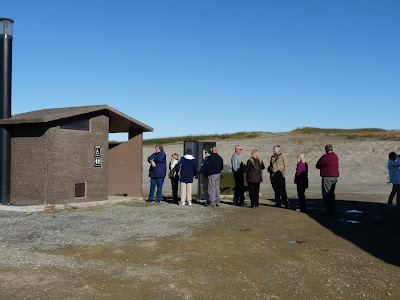
Our first stop of the day was Gobbler's Knob.We stop not so much for the scenery but for the latrines. While pit toilets aren't the most pleasant experience the ones along the Dalton Highway are fairly clean and well maintained for being so isolated and unsecured.

Of course as we rode along our bus driver was giving us information about the area, what we were seeing and whatever else came to mind. We learned that there are pumping stations located at various points of the pipeline since the oil going downhill creates a lot of pressure in the pipeline. The pumping stations drain off some of the oil until the pressure goes down, then repumps that extra oil back into the pipeline. There are also small metal sheds placed along the roadway which contain emergency supplies and equipment to repair the pipeline. We also learned that hunters can't rifle hunt within five miles of the pipeline so stray shots won't damage it. You can carry a sidearm within five miles of the pipeline, but only for personal protection from bears and wildlife, not to hunt. There was one person who deliberately shot the pipeline and when he was caught he was given a prison sentence of 20 years. So there's not a been too much of a problem with hunters.

For those that watch the show "Ice Road Truckers" the Dalton Highway is the Ice Road. Created by trucks spraying layer after layer of water which freezes, the ice road is created in winter to eliminate many of the curves of the actual roadway and speed up travel since spraying water fills the potholes so you can drive faster. Crazy f*ckers truckers.

In Alaska there are thermocast lakes which were created where the glaciers stopped moving and then melted, forming large holes which were filled with water. The lakes remain filled even though they are only fed by rain since it never gets hot enough for the lakes to dry up. We were traveling too fast at that point so my picture was too blurry to post.Here we are at our second stop of the day--the Arctic Circle, latitude 66 degrees 33'44". More importantly, it was another pit stop. Pit stops provide a lot of opportunities for photos since it takes a long time for 37 people to use a one-seater outhouse. Once we crossed the tree line, the men were offered the opportunity to pick out a bathroom tree to shorten the line to the latrine. Moving on....

Wolves on the mountainside--I really had to zoom for these so it's not the greatest picture.
This man is standing on a "pingo", which is a kind of frost heave. It's an earth covered ice mound.

I'm done for the day.

Sunday, September 12, 2010

Prudhoe Bay to Coldfoot


We had to have our bags outside our room by 7AM so they could be loaded on the bus so Denny and I were up early, hitting the buffet line for breakfast. We sat with one of the housekeepers who works at Prudhoe on a 2 week on/2 week off schedule, as well as with one of the cooks who was working a 3week/3 week schedule. These women have it a little harder than the men I think, as Prudhoe seems it would be a cold and lonely place. But the money is good--the housekeepers earn between $55,000-60,000 for the equivalent of 6 months work. The employees get their pay, their rooms, their food and their clothing provided by the oil company they work for. If they live in Anchorage or Fairbanks they get free plane fare to and from Prudhoe Bay. If they live in the lower 48 or elsewhere in Alaska they have to pay their own plane fare when they come back and forth every two to three weeks and that can cost them $700 a flight, so most find apartments/rooms in those two places. The employees are more than willing to talk to the tourists about their lives in Prudhoe Bay and elsewhere and most are content with this unusual lifestyle. One of the funny things was that there was a no cussing, no gambling rule. Yeah, I bet those get enforced!

Our first stop of the morning was to the general store in our Prudhoe Bay camp. Items and materials are delivered to the area in three ways; the Dalton (Ice) Highway, barges and air transport. Our group was soon to find that stopping at gifts shops was de riguere for our Princess Alaska land/cruise. The post office was also in the same building so some of us took pictures while others took the opportunity to purchase and send off post cards from Deadhorse, Alaska.

We were able to see some of the equipment and buildings more clearly in the bright morning sunshine. I forgot to mention in yesterday's post about the mobile modular units that sometimes those huge orange units on wheels are moved while the employees inside are still sleeping after their shifts!

There are no doctors in the oil camps around Prudhoe Bay but there are PAs--physician's assistants. If someone is injured too severely to be helped here, a helicopter is dispatched to pick them up and take them to Fairbanks or Anchorage.

There are three phases of weather by which the employees work with the worst phase being phase 3. In phase 3 you literally cannot see your hand in front of your face due to blowing snow and cold so everyone is placed in virtual lock down until the phase 3 is lifted. Our local guide Grant was once stuck in his security guard shack at the entrance to the oil field for three days while a phase 3 condition was in effect.

Grant also mentioned that members of his native culture (they use the word culture rather than tribe) crush the red leaves of a small plant that flourishes here with the white blossoms of another plant to create a soapy lather for washing.Who would have thought there were sand dunes in Alaska? But indeed there are and they provide an area for brown bears to make their dens. Are you learning anything yet?
I'm not sure of the proper spelling but our guide called these "rollagones". These monster machines have only 3 to 5 psi in the tires so the tires roll softly over the tundra without creating too much damage. The companies here are very conscientious about the ecology of the land and the limiting the damage that they do. In fact, they hire summer interns to walk on the tundra to pick up trash and these students have to have a special permit to walk on the tundra and permafrost because that is a practice that's not normally allowed here.

After everyone had shopped and taken their pictures at the store it was time for us to start heading down the Dalton Highway.We boarded the bus for the 240 mile trip to Coldfoot, traveling at 20 to 30 mph for the most part. Yeah, it was going to be a long day.


One of the things pointed out to us by our driver Chuck was that the pipeline had to have cooling coils installed along the sections since the oil comes out of the ground hot and the heat would melt the permafrost that the stanchions are built upon so the oil needs to be cooled as it flows through the pipes. There was so much the engineers had to think about and plan for in the few months they had to get this entire pipeline going. It truly is an engineering marvel.

After three hours of driving we had traveled 70 miles, passing from flat tundra to the Franklin bluff and working our way towards the Brooks Mountain Range. Not far past the bluffs we saw the musk oxen. I will apologize in advance for the quality of many of the photographs as most were taken from inside the buses and trains and therefore there is some window glare and blue coloring from the window tint.
Our first pit stop occurred about 90 miles down the Dalton Hwy and was going to become a familiar ritual over the next couple of days. While we were waiting our turn at the one-seater, our driver Chuck took some of us over onto the tundra to show us a piece that had been cut out so we could see what the ground looked like. Me, I was more interested in watching the hunters with their bows and arrows as I noted some caribou on the ridgeline near our stop. It seems in Alaska hunters can hunt from the roadways, simply stopping their vehicles, stepping out and shooting away. Scary.
Our driver, Chuck.

After watching the hunters for a few minutes we all boarded the bus again for our southward trek down the Dalton Highway. The tundra started to show more and more color and when we finally stopped to eat our box lunch that had been prepared by the kitchen staff at Prudhoe Bay, we enjoyed a terrific vista even though we were sitting on the berm of the gravel road like a bunch of first graders.


Because we had a nice sunny day, Chuck did not have to work hard at cleaning our windows so that we could view the scenery and the animals. This is a relatively clean bus for the Dalton Highway! And no dead mosquitoes smashed on the windows, either!

As we rode the group saw distant (as in white grains of rice) Dall sheep on far mountain sides, fall colors in the tundra, aspens turning golden and even a brown bear and cub along the pipeline. In Alaska it would be easy to have sensory overload, I think.

Finally, after nine and a half hours on the road, we arrived in Coldfoot. Again as we stepped off the bus we were handed our room keys and told our luggage would be delivered. Denny and I waited until we had gotten our bag and then wandered over to the camp's restaurant which was yet another buffet line. After dinner the two of us wandered over to the visitors' center across the highway and listened to a talk on mosquitoes. But it's been a long day of driving, Patches has jumped in front of the computer to let me know she wants to go for a walk and I am ready to get some fresh air myself.Spartan, no TV, no clock, no radio, no ambiance. But clean.

To be continued....
Related Posts Plugin for WordPress, Blogger...